
Summary
Editor's rating
Value for money: fair price if you know what you’re buying
Design: basic looks, functional layout
Comfort and handling: heavier, but manageable
Materials: glass composite tank, not a sports car
Durability: built to survive beginner abuse
Performance: gets the bait out there, nothing more
What you actually get vs what the listing suggests
Pros
- Tough glass composite blank that handles beginner abuse and rough handling
- Stainless steel guides offer decent saltwater resistance for the price
- Comfortable EVA grips and moderate action make casting easier for newcomers
Cons
- Heavier and less sensitive than carbon surf rods in a slightly higher price range
- Listing is confusing (only one rod, despite plural wording and 2-piece spec)

Specifications
View full product page →| Brand | Mitchell |
A budget surf rod you don’t mind abusing
I’ve been using the Mitchell Adventure 2 Surf 3.9 m for a few sessions now, mainly on a windy, shingly beach where gear takes a beating. I bought it as a spare / beater rod, something I wouldn’t cry over if it got knocked on the rocks or covered in sand. On paper it’s a glass composite surf rod, 100–250 g casting range, with stainless guides and EVA handle, clearly marketed for beginners and casual anglers.
My first impression when I unpacked it: it looks like a typical budget surf rod. Nothing fancy, nothing that screams high-end, but it doesn’t feel like a toy either. At just over 500 g, it’s not light, but when you’re used to old-school fibreglass or cheaper teles, it’s pretty normal. I paired it with a mid-size 6000 spinning reel and 0.30 mono and headed to the beach to throw 120–150 g leads with simple pulley rigs.
Over a few outings, the main thing that stood out is that the rod is forgiving and tough, but not very sensitive. It will survive clumsy casts and rough handling, which is good if you’re teaching someone or you’re not gentle with your gear. On the other hand, bite detection is average, and you’re not going to feel every little nibble like with a decent carbon blank.
So far, I’d describe it as a decent, no-nonsense starter surf rod. It gets the job done, especially if your expectations are realistic: it’s there to chuck a bait out and handle some basic surf fishing, not to give you top-tier performance or finesse. If you keep that in mind, it makes a bit more sense.
Value for money: fair price if you know what you’re buying
Looking at the overall package, I’d say the value is decent, especially if you catch it at the lower end of its usual price range. You’re getting a full-size 3.9 m surf rod that can handle real saltwater use, with stainless guides and a tough glass composite blank. It’s not refined, it’s not light, but it does the basics well enough for a beginner or as a spare rod.
Where some people feel a bit cheated is with the product listing wording: the use of “rods” (plural) and “2 pieces” can make you think you’re getting two rods, when it’s actually just one 2-piece rod. If you go in expecting a twin pack, the value obviously feels bad. If you understand that it’s one rod, then the price vs what you get is more reasonable. You’re not paying for a brand-new technology or premium components; you’re paying for a simple, durable surf stick that can survive some neglect.
Compared to slightly pricier entry-level carbon surf rods, you’re trading off weight and sensitivity for toughness. If you’re already a bit into surf fishing and you value bite detection and lighter weight, you might be better off spending more on a basic carbon model. But if you’re kitting out a beginner, need a rod to leave in the car, or just want something you don’t mind lending out, this Mitchell makes sense. It’s the kind of rod you buy knowing it’s not perfect, but it will do the job without you worrying too much.
So in terms of value, I’d rate it as good but not outstanding. There are better rods if you increase the budget, and there are cheaper no-name options that are worse. This one sits in that middle ground where, if you’re realistic about your expectations and understand what you’re buying, you’ll probably feel you got your money’s worth.
Design: basic looks, functional layout
Visually, the rod is black and blue, pretty standard for entry-level gear. No flashy wraps, no fancy carbon weave on show, just a straightforward blank with some simple decals. Personally, I don’t care much about looks on a cheap surf rod; I’m more interested in whether the guides line up properly and the joints are solid. On this one, the guide alignment out of the box was fine, and the ferrule fit between the two sections was snug without being a nightmare to separate.
The handle is EVA, split into a rear grip and a shorter front grip with a screw-down reel seat. The EVA itself is not premium, but it’s not that shiny, slippery foam you sometimes get on very cheap rods. It has a bit of texture, which is good when your hands are wet or covered in bait. The reel seat held my 6000-size reel tight, no wobble, no need for tape. After a few sessions, the threads haven’t clogged up with sand too badly, which is always a concern on the beach.
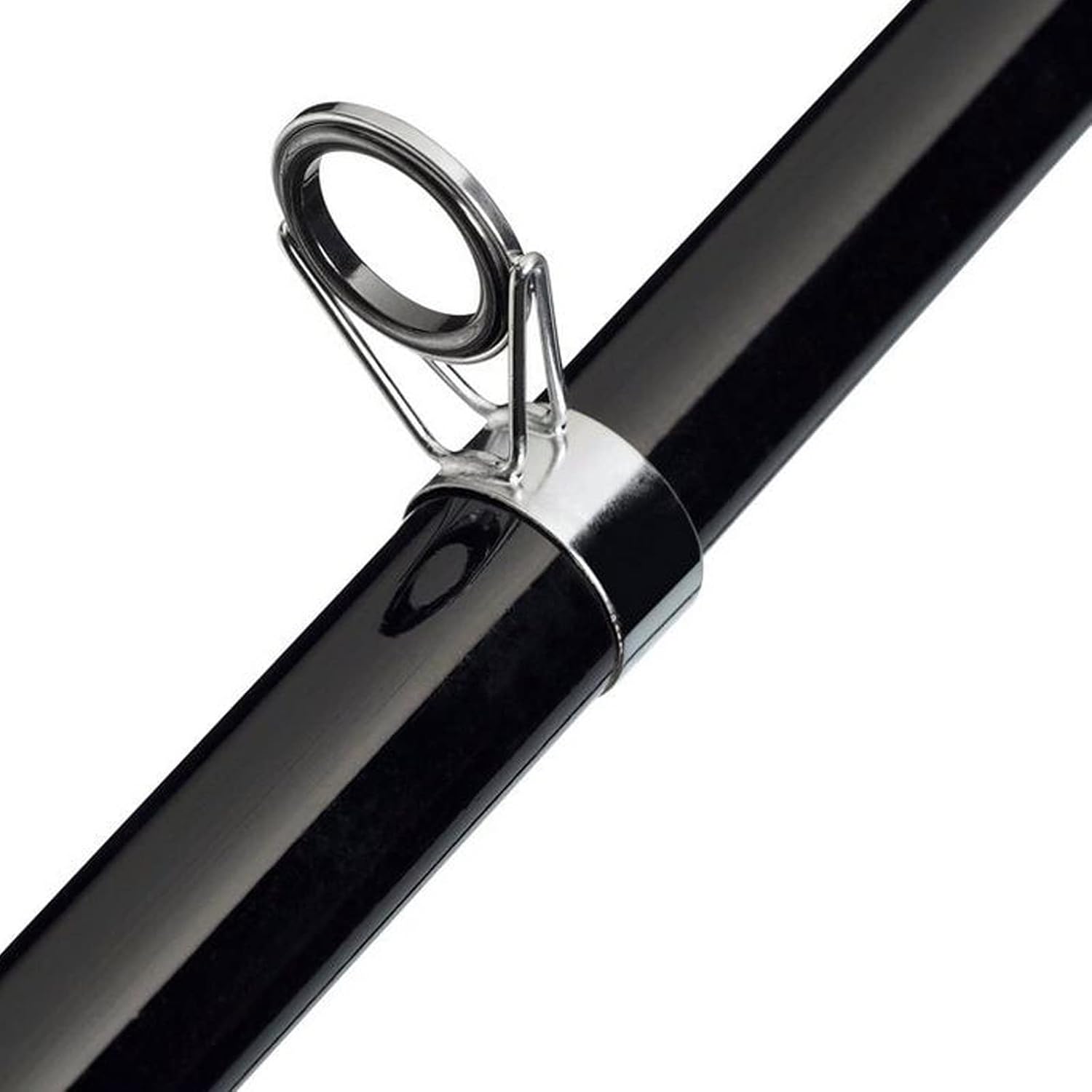
The guide layout is fairly standard for a surf spinning rod: larger stripper guide near the reel, then progressively smaller guides up to the tip. The stainless steel guides are not fancy, but at least they’re saltwater-proof stainless, which is what matters. The frames are a bit chunky, which adds weight, but they feel robust. I haven’t had any inserts pop out or rings bend yet, even after a couple of clumsy knocks on the groynes.
In terms of action, it’s listed as moderate, and that matches what I felt: it has a fairly soft mid-section with a bit more power in the lower third. This makes it easier for beginners to load the rod with a simple overhead cast. You won’t get competition-level distance, but you also won’t snap it easily with a bad technique. The design is clearly leaning towards forgiveness and durability, not sensitivity and long-range performance, which is fine for the target audience but something to keep in mind if you’re an experienced surf angler.
Comfort and handling: heavier, but manageable
At about 532 g, this rod is not light, especially at 3.9 m. You feel the weight when you’re holding it for a long time, but in real surf fishing, the rod usually sits in a rest, so it’s not a deal-breaker. The people complaining about weight on paper are probably comparing it to higher-end carbon rods. On the beach, when you’re just casting and then parking it, the weight is noticeable but not a big problem.
The EVA grips are actually pretty decent in use. They’re soft enough to be comfortable but not so squishy that they twist in your hands when you’re casting hard. I did a session of repeated long casts with 120–150 g leads, and my hands and wrists felt fine. The butt section gives you enough leverage for a decent swing without digging into your side too much. For someone new to surfcasting, the more moderate action also helps, because the rod loads easily without you having to put your whole body into every cast.
When fighting fish (I’ve only had schoolie bass and some dogfish on it so far), the rod bends smoothly and absorbs head shakes well. You don’t get that super crisp feel of a stiff carbon blank, but it’s quite forgiving on lighter hook holds. That makes it good for beginners who might be a bit clumsy striking or pumping fish in through the surf. The downside is that bite detection is average. Small knocks from shy fish don’t always show clearly, especially if there’s weed or a bit of swell.
In terms of overall comfort, I’d say it’s fine for casual sessions, not something I’d want to hold all day lures-only. For bait fishing with a rod rest, it’s completely acceptable. If you’ve got shoulder issues or you’re used to very light rods, you might find it tiring, but for a starter surf setup, the comfort level is reasonable and in line with the price.
Materials: glass composite tank, not a sports car
The blank is fibreglass / glass composite, and you can feel it immediately. It’s heavier and a bit more ‘spongy’ than a carbon rod of the same length. The upside is that glass is usually harder to break, especially with beginner mistakes like high-sticking or sudden jerks when you’re stuck in weed. I’ve put some ugly pressure on this rod freeing snagged rigs, and it just bent and came back, no creaks, no scary noises.
The guides are stainless steel, which is a big plus for a cheap surf rod. A lot of low-end rods still use cheaper metal that rusts fast in salt. After several salty sessions and half-hearted rinses, I’m not seeing orange rust spots yet, just the usual light marks from use. I’m not saying they’ll last forever, but for the price, the corrosion resistance seems decent. The inserts look like basic hard ceramic, not fancy SiC or anything, but my braid and mono run through them smoothly with no noticeable wear so far.
The EVA handle material is okay. It’s not super dense, but it hasn’t started tearing or compressing badly after a few trips. With wet, sandy hands, it still gives enough grip. The reel seat is generic but functional plastic/metal. It doesn’t scream quality, but it holds up under load and doesn’t flex or crack when you’re really leaning into a fish or a snag. For a rod in this price range, that’s pretty much all I ask.
Overall, the materials are clearly chosen for durability and low cost, not lightness or finesse. If you’re used to mid-range carbon surf rods, this will feel like a club in comparison. But if you want something that can live in the car, get bashed around, and survive a season or two of casual saltwater trips, the material choices make sense. It’s a rod you can lend to a mate or a kid without stressing about them babying it.
Durability: built to survive beginner abuse
This is probably the rod’s strongest point: it feels hard to kill. The glass composite blank, the chunky stainless guides, and the basic but sturdy reel seat all give the impression that it’s made to take some punishment. I’ve already done a few things with it that I’d never try with a more expensive carbon rod: high-sticking a bit to lift fish in close, yanking on snagged leads, and resting it awkwardly on rocks while sorting tangles. So far, no cracks, no loose joints, no guide frames bending.
The stainless steel guides are a big part of this. On cheap rods with poor-quality metal, you often see rust starting after just a couple of salty trips, especially if you’re lazy with rinsing. With this one, after multiple sessions with only a quick hose-down at home, I’m not seeing serious corrosion. The frames still look solid, and the inserts are all intact. I’m sure they’ll eventually show wear if you fish hard, but for a budget rod, the saltwater resistance seems above average.
The 2-piece construction also helps with durability compared to some telescopic rods. There are fewer weak points, and the ferrule joint is tight without being impossible to separate. It doesn’t twist or wobble under load, which is something I’ve had with cheaper teles. The EVA handle and reel seat area haven’t shown any signs of cracking or coming loose, even after some heavy pressure on snags and repeated tightening/loosening of the reel seat.
Will it last forever? Probably not. But as a starter or backup surf rod, I’d expect it to survive a couple of seasons of casual use, even with a beginner who isn’t gentle with their gear. That’s kind of the whole point of this rod: it’s not pretty, not super refined, but you don’t feel like you have to babysit it. For the price bracket, the durability is one of the main reasons I’d consider it.
Performance: gets the bait out there, nothing more
Performance-wise, the rod does exactly what you’d expect from a budget glass composite surf rod: it throws a decent weight a reasonable distance, handles average surf fish without drama, and doesn’t complain too much when you mistime a cast. With around 120–150 g of lead plus a simple bait rig, I was getting respectable distances using just a basic overhead thump, nothing fancy. It’s not going to compete with high-end distance rods, but for fishing close to medium range, it’s fine.
The action is moderate, so the rod bends quite a bit through the middle when you load it. That helps beginners time the cast, because you can feel the blank working rather than it just feeling like a broom handle. On the other hand, that same softness means that beyond a certain point, you’re just throwing effort away. When I tried to really punch a 170 g lead, the rod felt a bit overloaded and sloppy. So in real use, I’d say ignore the 250 g top end and stay around 150 g if you want it to feel controlled.
On the retrieve and in a fight, the rod has enough backbone low down to pull fish through the surf and a bit of weed. I’ve dragged in snagged rigs and clumps of weed without feeling like it was about to explode. For typical UK/European beach species (bass, flatfish, whiting, small rays, dogfish), it has more than enough power. You’ll only really find its limits if you hook into something properly heavy or start using it in very rough conditions it wasn’t designed for.
As for sensitivity, it’s serviceable but not sharp. You’ll see clear bites, but you won’t be reading every tiny pluck. For a beginner’s rod, that’s not such a big deal, but if you’re used to feeling everything through a crisp carbon blank, this will feel muted. Overall, the performance is honest: it works, it casts, it lands fish, but it’s nothing special. Perfectly acceptable as a first surf rod or a backup/beater setup.
What you actually get vs what the listing suggests
The listing is a bit confusing, and you can see that in the reviews. It says “Adventure 2 Surf Fishing Rods” (plural) and mentions “number of pieces: 2”, which some people clearly assumed meant two separate rods. In reality, you get one rod made of two sections. So if you’re thinking you’re getting a twin pack for this price, you’re not. It’s just a standard 2-piece surf rod, 3.9 m long when assembled, which is about 13 ft.
Out of the packaging, you get: the rod in two sections, no cloth bag, no extras, no reel. It’s just the bare rod, so you need to already have or buy a reel, line, and terminal tackle. The product name also mentions “Tele Surf Rod” in some specs, which is misleading, because this specific one is listed as a 2-piece, not a telescopic with multiple collapsing sections. Mine is definitely a straight 2-piece, not a tele, so that’s worth noting if you hate telescopics.
The stated casting range is 100–250 g, but the other specs mention a max lure weight of 150 g and a typical lure weight around 115 g. In practice, I’d say it feels best around 120–150 g plus bait. You can lob 170–180 g if you’re not power casting, but I wouldn’t be hammering full pendulum casts with 200+ g on this. The blank feels more like a medium-heavy, all-round surf rod than a real heavy-distance tool.
Overall, the presentation is pretty basic: budget-level finish, simple graphics, and minimal info. It’s not confusing once you actually have it in your hands, but the Amazon page could be clearer about the fact that you only get one rod and that this is a 2-piece, not a proper telescopic. If you’re used to bargain surf rods, none of this will shock you, but don’t expect premium packaging or a detailed spec sheet in the tube.
Pros
- Tough glass composite blank that handles beginner abuse and rough handling
- Stainless steel guides offer decent saltwater resistance for the price
- Comfortable EVA grips and moderate action make casting easier for newcomers
Cons
- Heavier and less sensitive than carbon surf rods in a slightly higher price range
- Listing is confusing (only one rod, despite plural wording and 2-piece spec)
Conclusion
Editor's rating
The Mitchell Adventure 2 Surf 3.9 m is basically a tough, no-frills starter surf rod. It’s heavier and less sensitive than carbon options, but the glass composite blank and stainless guides make it pretty hard to break and reasonably resistant to saltwater. It will throw 120–150 g leads a fair distance, handle typical surf species, and forgive a lot of beginner mistakes. If you treat it as a beater rod or a first step into beach fishing, it makes sense.
It’s not without issues. The product listing is confusing, and you only get one rod, not a pair. The claimed casting range up to 250 g is optimistic in real-world use; it feels happier below that. Bite detection is average, and the overall feel is on the clunky side compared to even mid-range carbon rods. But for the price, you’re mainly paying for durability and simplicity, not finesse. If you’re a casual angler, a beginner, or someone who wants a spare rod to keep in the car or lend to friends, it’s a fairly solid choice. If you’re already serious about surfcasting and want long-range performance and sensitivity, you’ll probably want to skip this and look higher up the range.