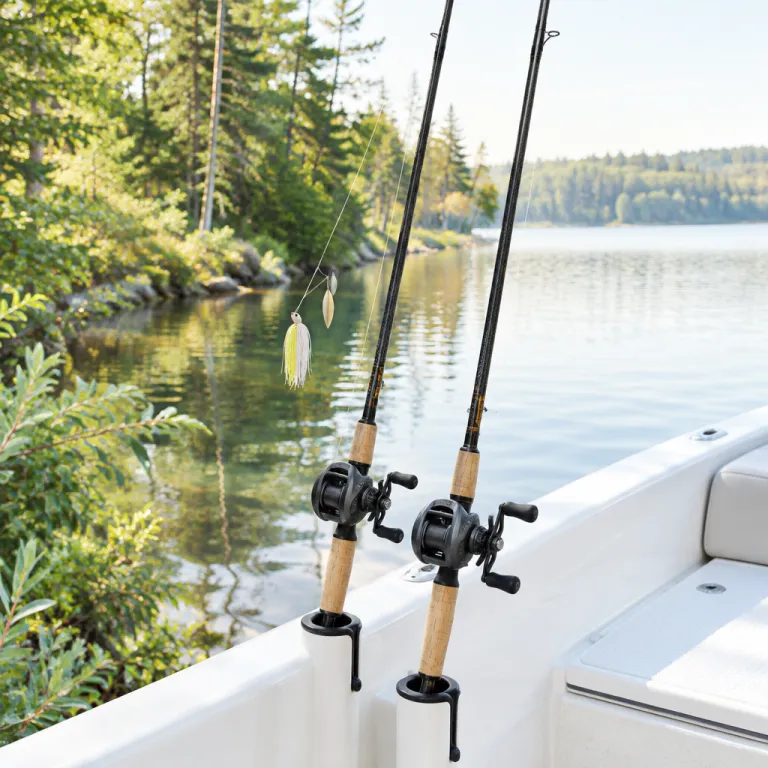
Why a dedicated spinnerbait rod changes how you fish
A purpose-built spinnerbait rod keeps the blades turning, the bait tracking straight, and your line under steady tension. With the right rod action you feel every vibration from the spinnerbait and instantly notice when the blades stop pulsing, which often signals a fish striking or following. A general-purpose casting rod can work in a pinch, but a rod designed specifically for spinnerbaits delivers tighter line control, cleaner hook sets, and more consistent presentations in changing water conditions.
Most recreational anglers start with versatile casting rods and only later realize how much a dedicated spinnerbait setup helps them cover water efficiently. Over the years many fishermen have switched from soft-tipped rods to a medium heavy backbone rod and immediately noticed better hook penetration and fewer lost fish near the boat. When you match rod power and taper to the weight of your spinnerbaits you can throw them farther, control bait depth more precisely, and steer hooked fish away from dock posts, rocks, and submerged timber.
Think about how you actually fish spinnerbaits during a day on the water. You cast around laydowns, dock posts, weed edges, and shallow flats where a rod that excels at accurate short casting matters more than raw distance. A good spinnerbait rod should load smoothly on the back cast, recover quickly after the rod throw, and still have enough backbone to pull a heavy fish out of cover without feeling like a broomstick.
Key characteristics of a good spinnerbait rod blank
The heart of any spinnerbait rod is the blank, which controls power, action, and overall feel. For most recreational fishing situations a medium heavy power rod with a fast action gives the best blend of casting distance, hook-setting strength, and control over the fish. Lighter medium power rods can work with compact spinnerbaits, but they often lack the backbone needed when a big fish surges toward dock posts or buried brush.
Fast action means the upper third of the rod bends most under load, while the lower section stays firm and acts as a backbone that drives the hook home. This type of action keeps the spinnerbait blades running well even when you slow roll the bait along the bottom in deeper water or burn it high in the water column. Some anglers prefer slightly softer tips in certain series of rods, yet they still insist on a strong midsection that will not fold when a heavy fish hits at close range.
Modern graphite rods such as the Shimano Crucial series show how far spinnerbait-specific designs have progressed. That Shimano Crucial casting rod line offers medium and medium heavy models tuned for different bait weights, so you can pick a rod that excels with 7 g (1/4 oz) finesse spinnerbaits or a heavier blank for 21 g (3/4 oz) lures. When you invest in a quality rod you get consistent performance for years, instead of constantly replacing cheaper rods that never quite match your fishing style.
For anglers interested in how blank design translates to other techniques, custom catfish rod builders follow similar principles of power and action tuning, as explained in many detailed guides on why custom catfish rods change everything for serious anglers. Understanding those concepts helps you judge whether a spinnerbait rod blank truly suits your preferred water types and target species. Once you can read specifications with confidence, you stop guessing and start selecting rods that match your real fishing conditions.
Choosing the right power and action for different spinnerbaits
Not every spinnerbait rod suits every spinnerbait, because lure weight and blade configuration change how the blank loads. Compact baits with small Colorado blades or willow blades cast best on a medium power casting rod that bends enough to launch them without feeling whippy. Heavier spinnerbaits with large tandem blades need a medium heavy or even heavy power rod so the blank does not overload on the cast or feel sluggish when you throw into the wind.
When you fish shallow stained water with Colorado blades you often slow roll the bait, which demands a rod action that keeps steady pressure without ripping the lure away from tentative fish. A fast or moderate-fast action spinnerbait rod cushions surges near the boat while the stronger lower section of the blank keeps control when a bass dives under dock posts or into grass. In clearer water you might burn double willow spinnerbaits just under the surface, and here a crisp fast action helps you maintain contact and instantly react when the blades suddenly stop.
Think of rod power as the backbone and action as the personality of the blank. A rod with too stiff an action can pull hooks free, while a rod that is too soft makes it hard to drive a single hook through tough jaws at the end of a long cast. If you want a deeper dive into how power and action affect other lure techniques, a resource on how to choose the best inshore casting rod explains similar trade-offs for coastal fishing, and the same logic applies when you fine-tune your spinnerbait rod selection.
Matching rod length and handle design to your fishing style
Rod length plays a major role in how a spinnerbait rod behaves around cover and open water. Shorter rods around 1,90 m to 2,00 m (6 ft 3 in to 6 ft 6 in) excel for target casting to dock posts, laydowns, and tight shoreline pockets where accuracy matters more than raw distance. Longer rods from 2,05 m to 2,15 m (6 ft 9 in to 7 ft 1 in) help you throw heavier spinnerbaits farther, pick up line quickly on a long hook set, and steer fish away from obstacles in deeper water.
Handle design also influences how well you control the bait and manage fatigue during a long day of fishing. A full cork grip on a medium heavy casting rod gives a secure hold when you lean into a hook set, while split-grip designs reduce overall rod weight and shift balance closer to the reel. When you repeatedly throw spinnerbaits all day, a balanced rod with the right handle length lets you keep your wrist relaxed and your rod tip low without strain.
Some anglers prefer shorter handles for roll casting under overhanging branches and around marina posts, because the butt does not catch on clothing or life jackets. Others like longer handles on heavy power rods to gain leverage when fighting strong fish that bury into grass or timber. Whatever your preference, test how the spinnerbait rod feels with your reel mounted, since the combined balance determines how naturally you can work the bait and react when a fish suddenly loads the rod.
Line, reel, and terminal tackle that complement a spinnerbait rod
A well-chosen spinnerbait rod only performs at its best when matched with suitable line and reel. Most recreational anglers pair a medium heavy casting rod with a low-profile casting reel spooled with 10 kg to 14 kg (20 lb to 30 lb) fluorocarbon or copolymer line for general-purpose spinnerbait fishing. In heavy cover or muddy water you might step up to 16 kg (35 lb) line on a heavy power rod to muscle fish away from dock posts, rock piles, and thick vegetation.
Fluorocarbon sinks slightly and helps keep the bait down, which is useful when slow rolling spinnerbaits with Colorado blades along the bottom in deeper water. Monofilament floats more and stretches, which can be helpful when fish swipe at the bait near the surface and you want a small delay before the hook set, especially with lighter rods. Braided line works well around dense cover, but pairing braid with a very fast action backbone rod can lead to pulled hooks unless you back off the drag or use a short fluorocarbon leader.
Do not overlook terminal tackle details such as snap quality and hook sharpness, because they interact directly with how your spinnerbait rod transmits power. A rod that is great at driving hooks still fails if the hook point is dull or the wire bends under pressure from a heavy fish. While you refine your overall gear setup, remember that tools like corrosion-resistant pliers also matter offshore, and a guide on the best fishing pliers for saltwater success illustrates the same attention to detail you should apply to every part of your spinnerbait system.
Real world scenarios to test your spinnerbait rod choice
The easiest way to judge a spinnerbait rod is to fish it in varied real world situations. Start with a medium heavy casting rod and a 14 g (1/2 oz) spinnerbait, then work along a shoreline with scattered dock posts, grass clumps, and small laydowns to see how accurately you can place the bait. Pay attention to how the rod loads on short roll casts, how quickly it recovers after each rod throw, and whether you feel the blades pulsing clearly through the handle.
Next, move to deeper water and slow roll heavier spinnerbaits with Colorado blades along the bottom, watching how the rod action helps you maintain contact without snagging constantly. A good spinnerbait rod should transmit the thump of the blades and the subtle change when the bait ticks rocks, shell beds, or submerged timber, while still offering enough backbone to lift a heavy fish away from cover. Over several years of fishing the same spots you will notice which rods in your series of setups consistently land more fish and which ones feel tiring or vague.
Finally, test your rod collection in windy conditions where you must throw spinnerbaits into or across the wind, because this exposes weaknesses in blank design and balance. If the rod feels underpowered or too soft, you will struggle to reach targets and keep the bait running well at the right depth. When you find a spinnerbait rod that handles all these scenarios with confidence, you gain a reliable tool that turns more follows into solid hook-ups and more bites into fish in the net.
Maintenance, durability, and long term value of spinnerbait rods
A spinnerbait rod that performs well out of the box still needs care to maintain its action and strength over many seasons. After each fishing trip rinse the rod with fresh water, especially if you fish brackish or lightly salty environments, then dry it before storage to protect guides and reel seats. Inspect the blank and guides regularly for nicks or cracks, because even a small chip can weaken the backbone and lead to failure under load from a heavy fish.
Transport habits also affect how long your rods last and how consistently they perform. Use padded sleeves or a rod tube when carrying multiple rods so that tips and guides do not bang against each other or against metal posts in the boat, which can create hidden damage that only appears when you lean into a hard hook set. Over the years a well-maintained medium heavy casting rod will keep its crisp feel, while a neglected group of rods often develops loose guides, worn grips, and flat spots in the blank that dull sensitivity.
When evaluating long term value, consider how often you fish spinnerbaits and in what conditions. Anglers who regularly throw heavy spinnerbaits around dense cover should invest in higher quality rods such as the Shimano Crucial series, because these blanks are engineered to handle repeated stress without softening prematurely. If you balance purchase price against performance and durability over several years, a good spinnerbait rod becomes one of the most cost-effective tools in your entire fishing arsenal.
Key statistics about spinnerbait rods and lure fishing performance
- In tournament bass fishing, spinnerbaits consistently appear among the top-producing moving baits on many U.S. reservoirs, according to long term results compiled by Bassmaster and similar organizations, which highlights the importance of pairing these lures with an appropriate spinnerbait rod.
- Rod length preferences commonly cluster between 1,95 m and 2,10 m (6 ft 5 in to 6 ft 11 in) for many competitive anglers using spinnerbaits, based on gear surveys from major retailers such as Bass Pro Shops and Tackle Warehouse, showing that mid length casting rods dominate this technique.
- Medium heavy power with fast action is the most frequently recommended specification for spinnerbait rods in manufacturer catalogs from brands like Shimano, Daiwa, and St Croix, reflecting a broad consensus that this combination balances casting distance, control, and hook-setting power.
- Graphite blanks used in modern spinnerbait rod series are typically advertised as significantly lighter than comparable fiberglass models in manufacturer technical sheets, which reduces fatigue during repetitive casting and improves sensitivity to blade vibration.
- Retailer and warranty data repeatedly show that rods transported without protective sleeves are much more likely to suffer tip or guide damage, underlining the value of basic maintenance and careful handling for any spinnerbait rod.
FAQ about spinnerbait rods
What power and action are best for a spinnerbait rod ?
For most recreational fishing situations a medium heavy power with a fast action offers the best balance for spinnerbaits. This combination provides enough backbone to drive a single hook through tough jaws while still allowing the tip to load for accurate casting. Lighter medium power rods suit smaller baits, but they can struggle with heavy spinnerbaits or thick cover.
What is the ideal length for a spinnerbait rod ?
Most anglers prefer spinnerbait rods between 1,95 m and 2,10 m in length. Shorter rods around 1,90 m excel at precise roll casting around dock posts and tight cover, while longer rods near 2,10 m help with longer casts and better line control in open water. Your choice should match whether you mainly target shallow shoreline structure or offshore points and humps.
Should I use fluorocarbon, monofilament, or braid with a spinnerbait rod ?
Fluorocarbon in the 10 kg to 14 kg range is the most versatile choice for spinnerbaits because it sinks slightly and offers good abrasion resistance. Monofilament works well for shallow presentations where you want more stretch and buoyancy, especially with lighter rods. Braid is useful in heavy cover, but you should pair it with a slightly softer action or a leader to avoid pulling hooks.
Can I use a general purpose casting rod for spinnerbaits ?
You can fish spinnerbaits on a general purpose casting rod, but performance may suffer. Rods that are too soft in the backbone make long distance hook sets difficult, while very stiff rods can rip hooks free at close range. A dedicated spinnerbait rod is tuned to handle the specific weights, blade resistance, and hook style of these lures.
How many spinnerbait rods should a recreational angler own ?
Most recreational fishermen can cover their needs with one or two spinnerbait-focused rods. A medium heavy fast action rod around 2,00 m handles most standard spinnerbaits, while a second rod in either lighter medium power or heavier power can cover finesse baits or very heavy lures. Building a small series of rods like this lets you adapt quickly to changing water clarity, depth, and cover density.