
Summary
Editor's rating
Is it worth the money compared to cheaper ultralights?
Looks like a “nice rod” without being overdone
Graphite blank, wood handle, and hardware that feels above entry-level
Built to survive trunk duty (plus the extra tip as backup)
On the water: casting light lures and handling surprise bigger fish
What you actually get out of the tube
Pros
- Good sensitivity and casting for light lures in a 6-foot ultralight format
- Includes hard canvas tube and extra tip section for better durability and convenience
- Clean build quality and components (Fuji reel seat, decent guides) at a fair price
Cons
- Fast action may feel a bit stiff for ultra-tiny lures and very finesse presentations
- Wood split grip is less grippy than cork when wet or in cold weather
- Price is higher than basic ultralight rods, so casual once-a-year anglers may not see the benefit

Specifications
View full product page →| Brand | Moonshine Rod Company |
A compact ultralight rod I actually want to keep in the car
I picked up the Moonshine Rod Co Rambler 6' ULF because I wanted a small, toss-in-the-truck spinning rod for trout, panfish, and the odd small bass. I was tired of cheap ultralights with soft noodles for blanks and guides that pop out after a season. The lifetime warranty and the extra tip section caught my eye, and the reviews were pretty strong, so I figured I’d give it a shot instead of buying another budget combo from a big-box store.
I’ve been using it with 2–6 lb mono and 4–8 lb braid, mostly on small rivers and ponds. I paired it with a 500–1000 size reel, similar to what one Amazon reviewer mentioned with the Tica Cetus. The overall setup is very light, so it’s the rod I grab when I just want to walk the bank for an hour or two and throw small spinners, jigs, and micro cranks. No fancy tests, just normal weekend fishing and a couple of after-work sessions.
In practice, this rod sits in that middle ground between “nice gear” and “I won’t cry if it gets beat up in the truck.” It’s clearly a step up from the usual cheap ultralight sticks, but it’s not some high-end boutique rod you’re scared to scratch. That balance is what I was looking for. I wanted something that feels good in the hand, has decent sensitivity, but can still live in a canvas tube behind the seat without babying it.
It’s not perfect. There are small things that bug me, like the action feeling a touch faster than I personally like on an ultralight and the fact that, for the price, some people will expect a full graphite handle instead of wood. But overall, after several trips and a handful of decent fish on 2–4 lb line, I’d say this Rambler earns its spot as a dedicated small-water rod that’s actually fun to fish, not just “good enough.”
Is it worth the money compared to cheaper ultralights?
On value, I’d put the Moonshine Rambler 6' ULF in the “good but not crazy cheap” category. You can definitely find ultralight spinning rods for a lot less at big-box stores, but they usually come with questionable guides, sloppy actions, and no real support if something breaks. Here, you’re paying extra for better components, a proper case, a spare tip, and a lifetime warranty with a reasonable service fee. If you fish regularly, that starts to make sense.
Compared to budget rods I’ve owned, the Rambler gives you better sensitivity, cleaner build quality, and a nicer feel in the hand. The fact that the Amazon reviews sit around 4.6/5 with over a thousand ratings lines up with my experience: it’s not perfect, but most people seem to feel they got their money’s worth. You’re not just paying for a logo; you’re getting a rod that actually fishes better than the cheap stuff and doesn’t feel disposable.
Where the value might be questioned is if you’re a very casual angler who fishes once or twice a year. In that case, a cheaper combo might be enough, and you’d never really notice the difference. Also, if you’re super picky and compare this directly to high-end JDM finesse rods, you’ll still see where the extra money goes at the top end of the market. This sits in a middle ground: noticeably better than entry-level, but not competing with premium rods that cost double or more.
For someone who wants a dedicated small-water, light-tackle rod that’s easy to transport and has some long-term support behind it, I think the price is fair. The extra tip and the case alone add real value if you’re the kind of person who’s broken rods in the past. If you just want the cheapest way to throw a beetle spin at bluegills a couple of times a summer, it’s overkill. But if you actually fish light tackle often, it feels like money reasonably well spent.
Looks like a “nice rod” without being overdone
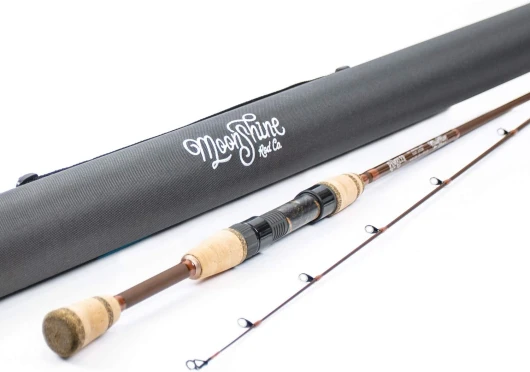
Design-wise, the Rambler 6' ULF goes for a “vintage brown” look with burled and dyed wood in the reel seat and copper-colored accents. It’s not flashy in a modern, neon way; it’s more of that old-school vibe. When you put a reel on it, it honestly looks more expensive than what you pay, which is probably why so many people compare it to rods that cost twice as much. Whether that matters to you or not is personal, but it does feel good to fish something that doesn’t scream “cheap combo.”
The split grip is one of the key design choices. Instead of a full cork or EVA handle, you get separate wood grip sections with exposed blank in the middle. In the hand, that means a slightly lighter back end and a bit more direct contact with the blank. It also just looks cleaner. The Fuji reel seat locks down the reel firmly; I didn’t have any loosening or wobble, even after a few hours of casting small spinners and working jigs. The micro guides are small but lined up well on my rod, no weird kinks or sloppy wrapping.
One thing to note: the fast action on an ultralight like this is a bit of a design tradeoff. The tip is soft enough to cast light lures, but the rod stiffens up pretty quickly as you load it. If you like very whippy, slow ultralight rods, this will feel different. For me, it made casting 1/16–1/8 oz stuff quite easy and gave better hook sets than the floppy budget rods I used before. But for tiny 1/64 oz jigs under a float, you do feel that faster backbone kicking in.
In short, the design leans toward practical with some style. It’s not some hyper-technical, minimalist build, but it’s also not cluttered with random cosmetics. The main gripe I could see some people having is that the wood and copper look is a bit “niche”—if you like super modern blacked-out gear, this won’t scratch that itch. Functionally, though, the layout makes sense, and everything is placed where it should be for relaxed spinning with light tackle.
Graphite blank, wood handle, and hardware that feels above entry-level
The Rambler uses a graphite blank with wood handles and a Fuji reel seat, plus American Tackle micro guides. On paper, that’s a decent list of components for this price range. In the hand, the blank feels crisp for an ultralight. When you shake it or load it on a fish, you don’t get that mushy feeling that some cheap fiberglass or low-grade graphite rods have. It recovers fairly fast after a cast, which helps accuracy when you’re trying to drop small lures next to cover.
The wood handle is the part some people will either like or complain about. It looks good and has a solid feel, but it’s not as grippy as cork when your hands are wet or cold. After a few trips, I got used to it, but if you’re coming from cork-only rods, it might feel different at first. The upside is that it doesn’t soak up water or get funky over time the way cheap cork can. The split grip also keeps the overall weight down and gives you more direct contact with the blank, which helps a bit with sensitivity.
The micro guides are small but seem well built. I ran both 4 lb mono and 8 lb braid with a fluoro leader, and I didn’t have any groove issues or weird noise through the guides. They’re not big, so if you use oversized knots or huge swivels, you’ll feel that. But for normal finesse setups, they work fine. The wraps and epoxy on my rod were clean—no big globs, no peeling or loose threads after several outings.
Overall, the materials feel a notch above typical budget rods, but not at the level of premium JDM or top-tier bass rods. For what you pay, the mix of graphite, quality guides, and a decent reel seat is fair. If I had to nitpick, I’d say some anglers might prefer cork over wood for grip and comfort, especially in colder weather. But in terms of basic build quality and materials, it gets the job done and doesn’t feel cheap or fragile in normal use.
Built to survive trunk duty (plus the extra tip as backup)
Durability is where this rod starts to justify its price a bit more. I’ve kept the Rambler in its canvas tube and tossed it in and out of the car, leaned it against rocks, and generally treated it like a tool, not a collector’s piece. So far, the blank has held up fine, no weird creaks or loosening at the ferrule. The 2-piece connection fits snugly—no twisting or gap forming after repeated assembly and breakdown. That’s a big deal if you’re packing it up and putting it together a lot.
The guides have stayed aligned and intact. I haven’t had any inserts pop out or crack, which I’ve had happen on cheaper rods after one bad knock. The finish on the blank hasn’t chipped or peeled, even after a couple of bumps against rocks and boat rails. The wood handle does show small marks more easily than cork or EVA, but that’s cosmetic. Functionally it’s still solid. I wiped it down a few times after muddy trips and didn’t see any swelling or issues.
One of the biggest durability pluses is the extra tip section and the lifetime manufacturer’s warranty (with a fee). I haven’t had to use the warranty yet, but just knowing that a snapped tip isn’t the end of the rod is reassuring. I’ve broken enough tips on car doors and tree branches to appreciate having a backup right there in the tube. That alone makes it feel like a safer buy than some similarly priced rods that give you zero support once you break something.
Is it bombproof? No. It’s still an ultralight graphite rod, so if you high-stick a big fish or slam it in a tailgate, it’ll break like any other. But for normal fishing abuse—trunk storage, occasional knocks, and regular weekend use—it feels pretty solid. Combined with the warranty and spare tip, I’m comfortable calling it a rod you can actually use hard without being paranoid every time you set the hook or toss it in the back of the car.
On the water: casting light lures and handling surprise bigger fish
Performance-wise, this 6' ULF is built for light tackle, and that’s exactly where it shines. I ran mostly 1/16–1/8 oz lures: small inline spinners, tiny cranks, and light jig heads with soft plastics. With 4–6 lb mono, casting distance is solid for a 6-foot rod. You’re not bombing lures across a lake, but for creek and small river work, it reaches anywhere I realistically need. The fast action helps load the blank even with lighter weights, so you don’t feel like you’re fighting the rod to get your lure out there.
In terms of sensitivity, it’s pretty good for this price. I could feel small ticks from panfish and subtle takes from trout in current. When bouncing small jigs along the bottom, I could tell the difference between rock, wood, and weeds well enough to adjust. It’s not on the level of high-end finesse rods, but compared to the budget ultralights I used before, it’s a clear step up. The blank transmits enough information that you’re not guessing what’s happening at the end of the line.
On fish handling, that wide 2–14 lb line rating is a bit optimistic, but it does have more backbone than the “ultralight” label suggests. Like one Amazon reviewer mentioned, it can handle bigger fish on 2 lb test without feeling like it’s about to explode. I hooked a couple of accidental larger bass and the rod bent nicely into the mid-section but still had control. The fast action helps set the hook quickly, especially with single-hook lures, and the softer tip keeps smaller trout and panfish pinned without tearing out hooks.
The downside: if you mainly throw super tiny stuff—like micro jigs under 1/32 oz or very light floats—the fast action might feel a bit stiff. A slower, softer ultralight would cast those better. Also, at 6 feet, you don’t get the reach you’d want for techniques like Euro nymphing or tight-line presentations; this is more of a general light spinning rod than a specialized tool. But used for what it’s intended—small lures, small to medium fish in freshwater—it performs reliably and is actually fun to fish.
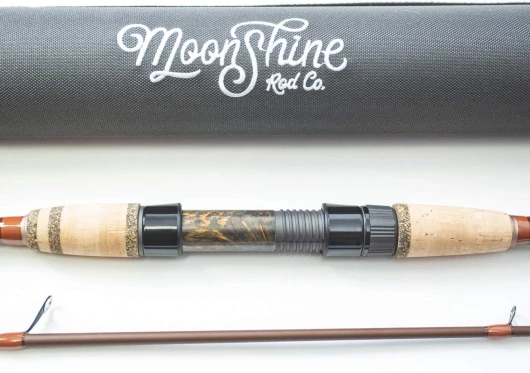
What you actually get out of the tube
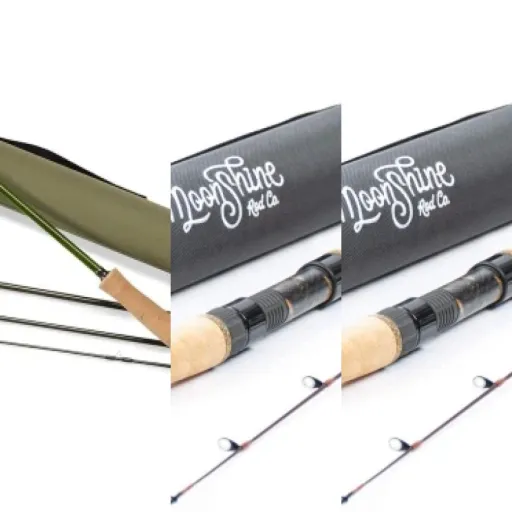
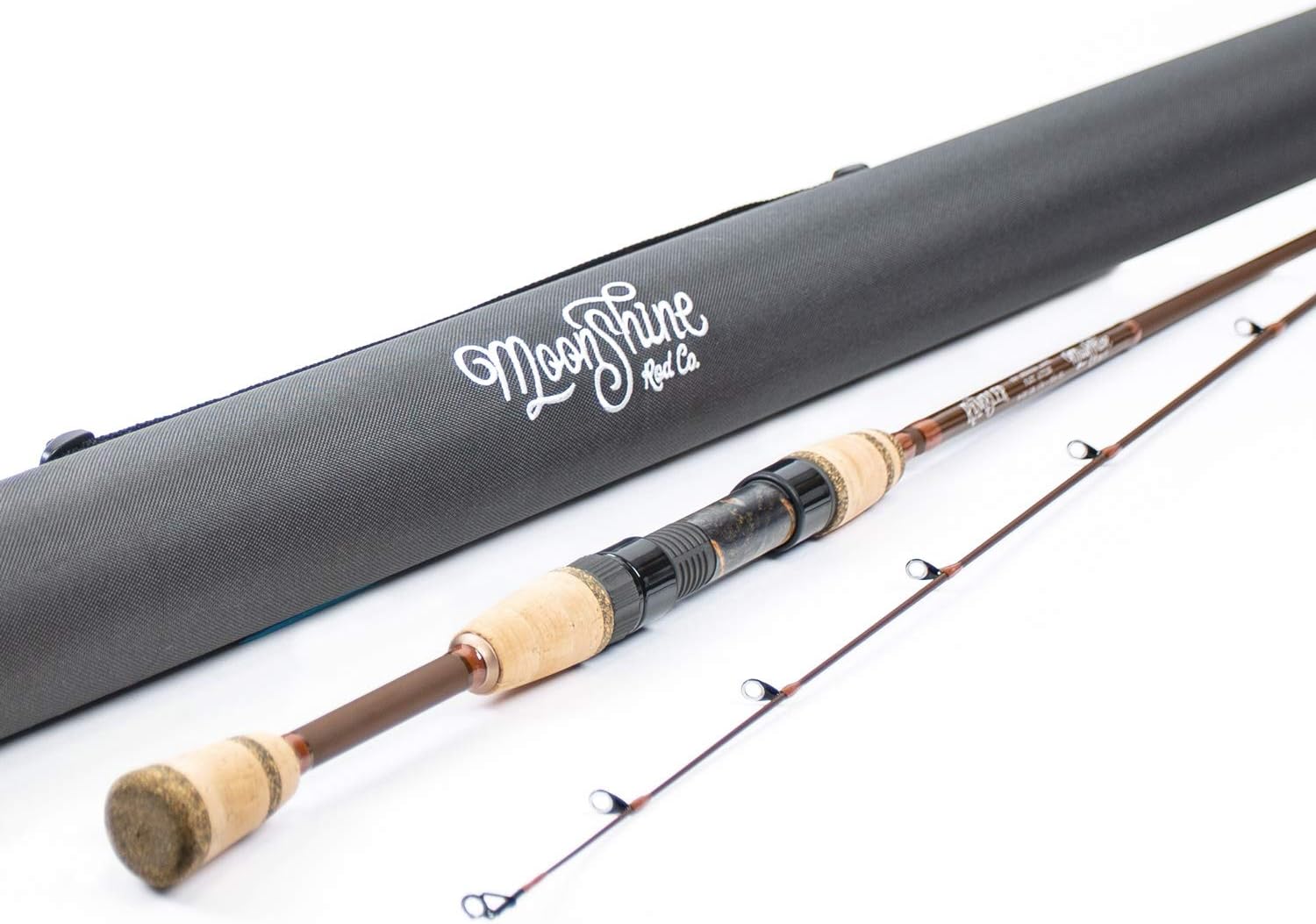
Out of the box, the Rambler 6' ULF feels like a proper piece of gear, not a toy. You get a 2-piece ultralight spinning rod, rated for 2–14 lb line (which is a pretty wide range), and it comes in a hard canvas tube with the Moonshine logo embroidered on it. The tube is compact enough to throw in a trunk or behind a truck seat and not worry about it getting crushed by other stuff. That’s honestly one of the big selling points: it’s ready to travel without needing to buy a separate case.
The rod itself is a 6-foot, fast-action, ultralight power stick. That means the tip bends pretty easily, but the lower part of the blank has some backbone. It’s built on a graphite blank with a split wood handle, Fuji reel seat, and American Tackle micro guides. You also get an extra tip section in the tube, which is a nice bit of insurance. I haven’t snapped a tip yet, but I’ve done it enough times on other rods to appreciate having a backup right there.
Moonshine markets this Rambler series as a kind of crossover between fly and conventional gear, but in practice this 6' ULF is just a compact ultralight spinning rod aimed at small freshwater work: trout, panfish, creek smallmouth, that kind of thing. It’s not a surf rod, it’s not a heavy bass jig rod. If you’re expecting it to handle big swimbaits or punch through heavy cover, that’s on you, not the rod. Used within its lane, it feels right at home.
Overall, the presentation is pretty solid for the price. You’re not buried in marketing junk or foam filler; you get the rod, the tube, and the spare tip, and that’s about it. For someone who just wants a decent travel-friendly ultralight setup with a bit of character, it ticks the main boxes right away. If you’re used to cheap rods in plastic sleeves, this feels like a step up without being over the top.
Pros
- Good sensitivity and casting for light lures in a 6-foot ultralight format
- Includes hard canvas tube and extra tip section for better durability and convenience
- Clean build quality and components (Fuji reel seat, decent guides) at a fair price
Cons
- Fast action may feel a bit stiff for ultra-tiny lures and very finesse presentations
- Wood split grip is less grippy than cork when wet or in cold weather
- Price is higher than basic ultralight rods, so casual once-a-year anglers may not see the benefit
Conclusion
Editor's rating
The Moonshine Rambler 6' ULF is a solid ultralight spinning rod for people who actually get out and fish small waters on a regular basis. It casts light lures well, has enough backbone to handle surprise bigger fish on light line, and feels noticeably better than the usual bargain-bin ultralights. The included hard canvas tube and spare tip make it an easy rod to keep in the car or boat without stressing about breaking it and being done for the day. The materials and hardware are decent, and the lifetime warranty with a service fee is a practical safety net if you’re rough on gear.
It’s not the cheapest option, and it’s not some high-end finesse rod either. If you only fish a couple of times a year, or you mainly throw heavy lures or fish big rivers and lakes, this isn’t the right tool. The fast action might also feel a bit stiff if your main thing is casting ultra-tiny jigs or floats. But if you’re into trout, panfish, or light bass fishing in creeks and smaller lakes, and you want a rod that’s easy to live with, looks decent, and holds up to regular use, the Rambler 6' ULF is a pretty solid choice. It does its job without drama, and for me, that’s enough to keep it in the regular rotation.